
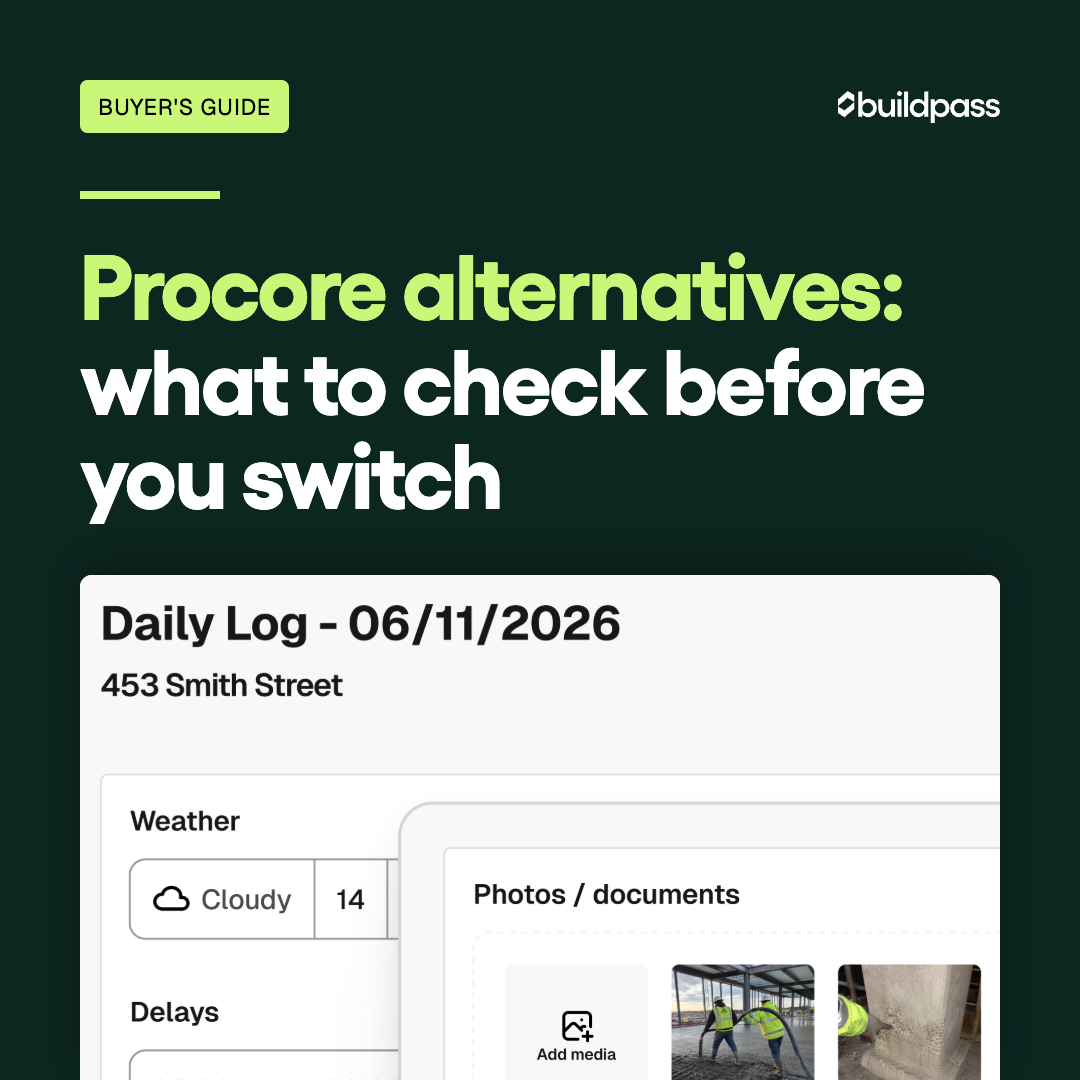
Procore alternatives: what to check before you switch
Running 5-20 projects and outgrowing your current platform? Here's a practical framework for evaluating construction management software before you commit.

The renewal quote arrives. The price is higher than expected, but the bigger question is whether your team is actually getting value from the platform.
For many builders, searching for a Procore alternative isn't about finding something "better". It's about finding software that fits how their business actually operates, without unnecessary complexity, unused features, or a site team that avoids using it.
Switching construction management software is a big decision. Before making the move, it's worth looking beyond feature lists and comparing the things that matter most: cost, adoption, migration, and whether the platform supports your team's day-to-day workflow.
This guide covers what to consider before switching, so you can decide whether a change is worth it.
Why builders start looking in the first place
Most builders don't start searching for a new platform because their current software completely fails. Usually, it's because the gap between what they're paying for and what their team actually uses keeps getting bigger.
A few triggers tend to come up again and again.
The cost no longer matches the value
Construction software pricing can become harder to justify as a business grows. A platform that made sense when you were managing a smaller number of projects can look very different once costs increase with project volume, users, or additional features. The issue isn't always the price itself. It's paying for functionality your team rarely uses.
The site team never fully adopted it
This is one of the biggest reasons builders start exploring Procore alternatives. The platform may be set up, training may have happened, and everyone may have access, but if supervisors and subcontractors are still relying on texts, emails, and spreadsheets, the system isn't delivering the value it should. On a busy construction site, people use the tools that make their day easier. If a platform feels slower than sending a quick photo or message, adoption will always be a challenge.
The platform feels too complex for the way you work
Enterprise construction platforms are built to support large, complex organisations, but that level of functionality isn't always the right fit for every builder. For mid-sized builders, the challenge is finding a platform that provides the tools they need without adding unnecessary administration. The goal isn't more software. It's better workflows that actually work for both office teams and people on site.
What to actually check before you switch
A software demo is designed to impress. Knowing what questions to ask before it starts is what separates a good decision from an expensive mistake.
Pricing model and total cost as you grow
Ask every vendor for the total annual cost based on where you expect to be in two years, not today. If they use per-user pricing, model it at the headcount you're growing toward. If they use volume-based pricing, ask how the rate changes at $20M, $40M, and $60M. Pricing transparency is not standard practice in this industry, and surprises at renewal are one of the most common complaints contractors have on any platform.
Every pricing model has trade-offs. The important thing is understanding how costs will scale over time and whether the pricing structure suits the way your business operates. Ask vendors to be clear about what's included, what may incur additional costs, and whether there are any implementation, support, or onboarding fees. Knowing this upfront makes it much easier to compare platforms and avoid surprises later.
Data migration
Before switching platforms, understand exactly what data can be migrated. Many construction management platforms can import core project information such as companies, contacts, project locations and active projects, saving your team from manually re-entering data. Knowing what's included in the migration process upfront will make the changeover much smoother.
Team adoption
A platform your site team won't use is no better than a spreadsheet. When evaluating a new system, look closely at the site experience. Ask:
- How does a new subcontractor access the platform?
- Do workers need training before they can use it?
- Can key tasks be completed easily from a phone?
- How quickly can someone complete an induction or sign-on?
The easier it is for new workers and subcontractors to use the platform without support, the more likely it is to become part of everyday site operations.
Construction-specific functionality versus generic project management
General project management tools can often be adapted to construction workflows. The problem is that adapting them takes time, configuration, and ongoing management. Purpose-built construction software is designed around workflows that happen every day on site, including WHS documentation, JSAs, inductions, site diaries, defects, drawings, variations, and project closeout. If these processes are central to how your projects run, look for software where they are built in, rather than added later.
Integration and exit
Does the platform connect with the tools your team already uses for scheduling, accounting, or document management? It's also worth understanding what happens if the platform doesn't work out. Ask:
- Can you easily export your data?
- What format will it be provided in?
- Are there additional costs involved?
Understanding the exit process before signing up can save significant headaches later.
What BuildPass is built for
If you're managing multiple active projects and your current platform feels like more than your team actually needs, BuildPass is built around the day-to-day operations that keep construction projects moving.
It helps teams manage inductions, daily reports, defects, WHS documentation, JSA processes, scheduling, forms, document management, and project closeout in one place.
The focus is keeping workflows simple for both office teams and site crews. A subcontractor who has never used BuildPass can scan a QR code on site, complete an induction, and sign on without needing lengthy training.
For builders considering Procore alternatives, the biggest question is often adoption. The right platform is the one your team will actually use every day.
Making the call
Switching is worthwhile when the cost of staying becomes greater than the cost of moving.
If your renewal is approaching and you can't justify the cost based on actual usage, that's a clear signal. If your team has stopped using the platform despite training and support, the issue may not be training. It may be the platform itself.
Before committing, test the new system on one live project. Run it alongside your existing processes for a few weeks and see what happens when real site teams use it.
The best construction software isn't necessarily the one with the most features. It's the one that fits the way your team actually works. Book a demo to see how BuildPass runs on a live project.
Frequently asked questions
What is the main reason mid-size builders switch away from enterprise construction software?
Pricing and adoption failure are the two most common reasons. Volume-based pricing models mean costs scale with annual construction volume rather than actual platform usage, which can make enterprise software feel punishing for a growing mid-size builder. Adoption failure, where the team stops using the platform after initial setup, is just as common and harder to diagnose from a software invoice. Builders running 5 to 20 projects often find that enterprise platforms were designed for contractors twice their size, with dedicated IT departments to manage configuration and training. The complexity that makes the platform powerful for a Tier 1 contractor becomes overhead for everyone else.
How long does it typically take to migrate data when switching construction management platforms?
It depends on how much data you have and what format your current platform exports. Simple migrations involving a clean CSV export of project records and a PDF archive of forms can be completed in days. More complex migrations involving years of site diaries, drawings, defects, and compliance documentation across dozens of projects can take several weeks, particularly if the new vendor does not offer migration support. The most important step is confirming what you can export from your current platform before you sign anything new.
Is per-user pricing or flat-rate pricing better for a growing builder?
Flat-rate pricing is generally more predictable for a builder growing their team. Per-user pricing can look affordable early and become a material cost as headcount increases. Volume-based pricing, which ties cost to annual construction volume, can also scale faster than expected as you win more work. Before committing to any pricing model, ask each vendor to give you the total annual cost at two to three headcount or volume scenarios, including where you expect to be in two years. Budget management is harder when software costs are unpredictable.
What construction-specific features should I look for that generic project management tools usually miss?
The features that matter most for field-based operations are rarely priorities in general project management platforms. Look for: WHS compliance documentation, SWMS and safety management workflows, inductions that site crews can complete on a phone without training, site diaries that work offline, defects, drawing management, change orders, and project closeout tools. Generic platforms can often be configured to approximate these workflows, but configuration takes time and expertise. If your site operations depend on these features, look for a platform where they are native, not bolted on.
How do I evaluate whether my site crew will actually adopt a new platform?
Ask the vendor to show you the worker-facing experience, not the admin portal. A new subbie who shows up on site on day one with no prior context should be able to scan a QR code, complete an induction, and sign on without calling anyone for help. If the worker app requires training or a reliable data connection, adoption on site is going to be harder. The fastest signal is to run a four to six week parallel test on one live project before committing. Field collaboration problems become obvious quickly once real site crews are using the platform.
What questions should I ask a vendor before committing to a switch?
The most useful questions are the ones vendors do not get asked often: What is my total cost at [X] users and [Y] in annual construction volume in two years? What can I export if I cancel, and in what format? How long before a site crew that has never seen the platform is using it without hand-holding? Who handles data migration and what does it cost? What does the worker experience look like on a phone with no signal? These questions surface what a demo is designed to keep in the background.
Are there alternatives to enterprise construction platforms that still cover SafeWork compliance and safety documentation?
Yes. A number of purpose-built construction management software platforms are designed specifically for mid-size builders and cover WHS compliance, SWMS documentation, safety management, inductions, and site diaries without the enterprise overhead. The distinction to look for is whether safety and compliance are core modules or add-ons. Platforms built around site operations tend to treat compliance as central. General project management platforms often treat it as a secondary feature set.
What is the best way to test a new construction management platform before fully committing?
Run a parallel test on one live project for four to six weeks. Choose a project that is active enough to give the platform a real workout, assign one project manager and one site crew, and track adoption honestly. The questions to answer during the test: Is the field crew using it without being prompted? Are site diaries, defects, and safety documentation being completed in the platform or still being handled by text and email? Is setup taking time away from the project? A parallel test costs time upfront and saves significantly more time if it prevents a failed full rollout.
More news you'll care about
Don't stop there, the BuildPass blog is filled with interesting insights and innovations that'll help you and your construction business stay ahead of the pack.