
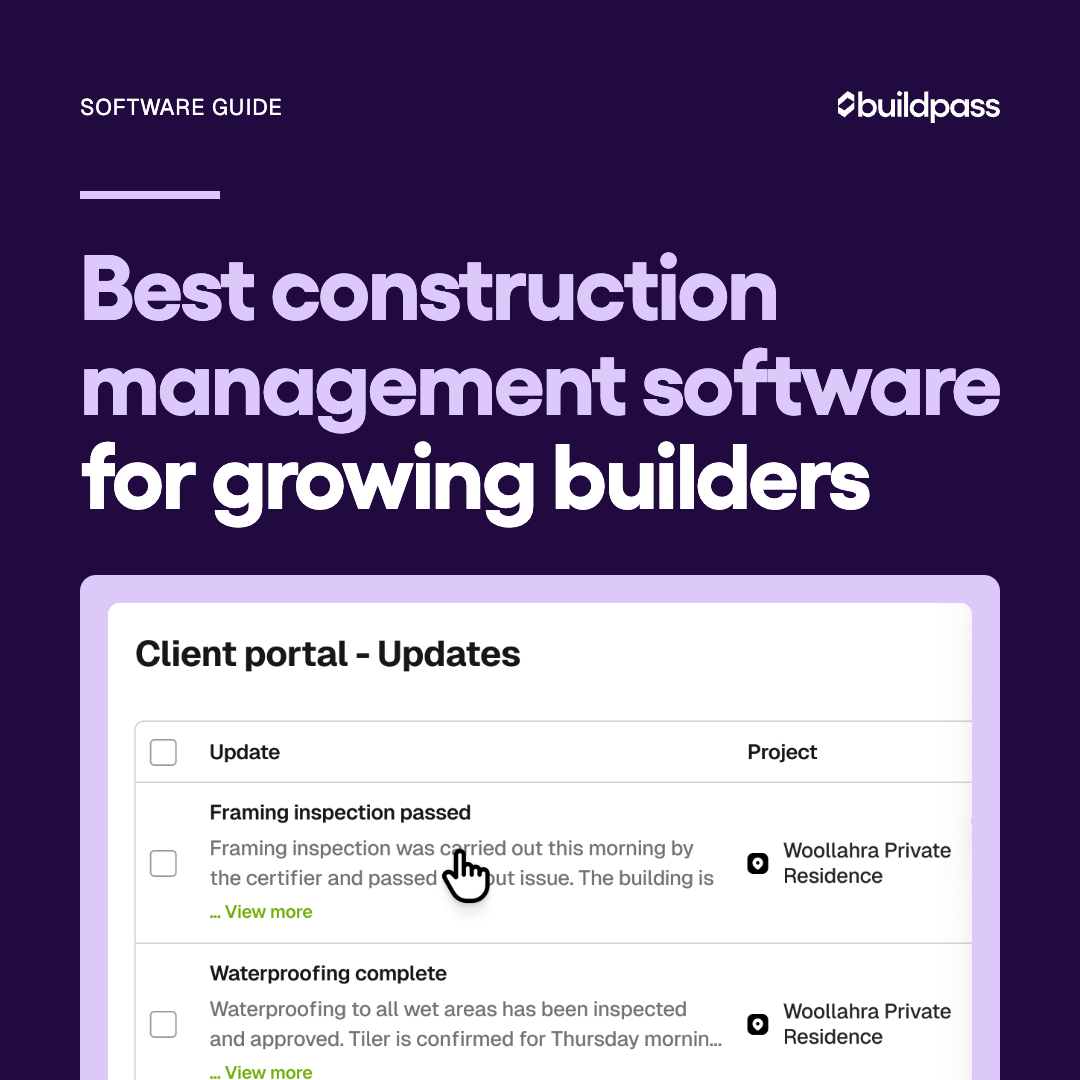
Best construction management software for growing builders
Running 5-15 projects and outgrowing spreadsheets? Here are the tools built for builders at your stage, and how to pick the right one.

There's usually a point where the systems that helped your business grow start creating more problems than they solve.
Spreadsheets, emails, shared drives, and group chats can work well when you're managing a small number of projects. But as you take on more jobs, more subcontractors, and more people across different sites, keeping everyone aligned becomes harder.
Documents get harder to find. Updates get missed. Safety records sit across multiple systems. Site teams spend time chasing information instead of getting on with the job. This is usually when builders start looking for construction management software.
The challenge is finding a platform that suits the way your business actually works. Some systems are designed for large construction companies with dedicated admin teams and complex processes. Others focus on helping growing builders simplify the day-to-day management of projects without creating more work.
What "growing builder" actually means (and why it matters for software)
A growing builder is usually at the stage where the old ways of managing projects are starting to show cracks.
You might still be able to keep track of everything across spreadsheets, emails, and shared folders, but the more projects you add, the harder it becomes to keep information consistent across your team.
Common challenges at this stage include:
- Safety documents stored across different locations
- Subcontractors arriving on site without completing inductions
- Difficulty tracking worker licences, tickets, and expiry dates
- Site updates getting lost in messages and emails
- Office teams lacking visibility into what is happening on site
- Project tasks and defects being followed up manually
The goal of construction management software is not to replace the way your team works. It's to give everyone one place to access the information they need, when they need it.
For growing builders, the right platform should be simple enough for site teams to use every day, while giving office teams the visibility they need to manage multiple projects.
What to look for in construction software at this stage
Before comparing construction management software, it's worth getting clear on what your business actually needs. The best platform is not necessarily the one with the longest feature list. It's the one that helps your team manage the work that happens every day across your projects.
For growing builders, key things to look for include:
- End-to-end operations, from preconstruction through to project completion. At this stage, growing contractors need more than individual tools for isolated tasks. Managing estimating, preconstruction, project delivery, documentation, and financial workflows across separate systems creates more places for information to get lost. Look for a platform that supports the full project lifecycle, helping teams stay connected from winning the work through to managing day-to-day operations on site.
- Simple onboarding for workers and subcontractors. If every new worker needs to be manually added, chased, and followed up by your office team, the process quickly becomes difficult to manage. Look for tools that allow workers and subcontractors to complete their own inductions and provide required information without adding extra admin.
- WHS compliance tracking built in. Safety documentation should be easy to access and keep up to date. Look for features that help manage SWMS, licences, tickets, training records, and other compliance requirements without relying on manual spreadsheets or reminders.
- Scheduling with critical path visibility. When you're managing multiple jobs, it becomes harder to see what needs attention across each site. Construction software should help your team track progress, upcoming tasks, and potential delays before they become bigger issues.
- Works on-site on any device. Your team needs access to information where the work happens. A platform that works smoothly on mobile devices makes it easier for supervisors and subcontractors to complete tasks, upload information, and stay updated while they're on site.
- Live on a real project in days. A six-month implementation timeline is a Tier 1 problem. You need to be running the tool on an active project quickly, with minimal setup overhead.
- Quick implementation without unnecessary complexity. Growing builders don't have months to spend configuring software. Look for a platform that can be introduced quickly and used on a live project without extensive training or a dedicated systems administrator.
- Doesn't create more admin work. Construction software should reduce paperwork and follow-ups, not add another task to the list. If keeping the system updated requires constant manual input, it's unlikely your team will continue using it.
The tools worth considering (and who each one fits)
There isn't one "best" construction management platform for every builder. The right choice depends on your project type, team size, and where your current processes are starting to break down.
Some platforms are designed for large construction companies managing complex projects, while others are built for growing builders who need better visibility across their day-to-day operations.
Here are some platforms builders commonly consider and where they tend to fit.
BuildPass
BuildPass is designed for growing construction companies who need a simpler way to manage day-to-day site operations across multiple projects. The platform brings key construction workflows into one place, including worker inductions, daily logs, safety documentation, forms, scheduling, document management, and project handover. Beyond project delivery, BuildPass also supports pre-construction and finance workflows, helping contractors manage everything from estimating and procurement through to job costing, invoices, and project performance.
For site teams, the focus is making everyday tasks easy to complete. Workers and subcontractors can scan a QR code to complete an induction, provide required information, and sign in without needing lengthy setup or training. For growing contractors, this helps reduce the manual follow-up involved in chasing documents, tracking compliance records, and keeping project teams aligned.
Procore
Procore is one of the most established construction management platforms globally and is widely used by large contractors and enterprise construction companies. Its strength is the breadth of tools available, covering areas such as project management, financials, quality, safety, and reporting.
For growing builders, the key consideration is whether the level of functionality matches what the business needs today. Larger platforms can require more implementation time, internal ownership, and ongoing administration, so it's important to consider whether your team has the resources to get full value from the system.
Buildertrend
Buildertrend is primarily designed for residential builders, remodelers, and custom home builders. It provides tools for areas such as scheduling, client communication, budgeting, selections, and project management, making it a popular option for residential businesses looking to move away from spreadsheets and disconnected systems.
The main consideration is whether it supports the full range of workflows your projects require, particularly around site operations, compliance, and subcontractor management.
Fieldwire
Fieldwire focuses primarily on field coordination, drawings, tasks, and defect management. It can be a useful tool for teams looking to improve communication around site tasks, drawings, and quality control. However, builders looking for a complete construction management platform may need additional tools alongside it for areas such as inductions, safety documentation, scheduling, and broader project management.
What happens when you pick the wrong tool
The biggest mistake growing builders make is choosing software that doesn't match the way their team actually works.
A platform might have every feature you need on paper, but if it's difficult for site teams and subcontractors to use, adoption quickly becomes a problem. The office might complete the setup, but if supervisors and workers find the process too complicated, they'll often return to what they know: phone calls, emails, spreadsheets, and messages.
The opposite problem can happen too. A tool that works well for a smaller builder may not provide enough visibility once you're managing multiple projects. Tracking safety documents, subcontractor information, project updates, and defects becomes much harder when everything is stored in separate places.
The right construction management software should make your existing processes easier to manage, not create another layer of administration.
How to trial a platform without wasting a month on it
The best way to evaluate construction management software is to test it in a live project.
A demo can show you what a platform does, but it won't tell you whether your team will use it day to day. Before committing, trial it with your actual workflows and people. Here is a practical approach:
1. Start with one active project
Avoid testing on a sample project or empty account. Choose a current job that reflects the type of work you do and use it to see how the platform handles real site communication, documentation, and compliance.
2. Get your site team involved early
The people using the platform on site should be part of the decision. Ask your site supervisor or foreman to use it during their normal workflow. If it feels simple and saves time, adoption is much more likely.
3. Test the subcontractor experience
Your team might understand the platform, but subcontractors need to be able to use it without unnecessary steps. Test how easy it is for a new worker to complete an induction, provide documents, or access site information.
4. Check whether it reduces admin
After a week or two, look at what has changed. Are you spending less time chasing documents, following up subcontractors, and searching through emails or spreadsheets? The right platform should reduce admin, not create more of it.
5. Review what information you actually have access to
A good system should make it easier to see what's happening across your projects. Check whether you can quickly find important information like completed inductions, current documents, safety records, and project updates.
6. Make a decision based on real usage
Don't let a trial run indefinitely. A couple of weeks using the platform on a real project should give you a clear idea of whether it fits your team and the way you work.
If you want to see what BuildPass looks like for a builder at your stage, book a demo and we will walk through a live project with you.
Frequently asked questions
What size construction company actually needs project management software?
There's no exact number, but many builders start looking for construction project management software when they are managing multiple active projects and information becomes harder to keep organised. As the number of jobs, subcontractors, and site teams grows, it becomes more difficult to keep everyone working from the same information. Documents can become spread across emails and folders, safety records can be harder to track, and important updates can get missed. This is usually the point where a dedicated construction management platform starts adding value by helping teams manage documents, WHS processes, communication, and day-to-day site operations in one place.
What is the difference between construction management software built for small builders versus enterprise platforms?
The biggest difference is usually complexity. Enterprise platforms are designed for larger construction companies managing complex projects, multiple teams, and detailed reporting requirements. They can offer extensive customisation, but they often require more setup, training, and ongoing management. Software designed for growing builders focuses on making everyday tasks easier to manage without adding unnecessary administration. The goal is to give teams visibility across projects while keeping workflows simple enough that both office teams and site teams will use the system.
Which construction software features matter most when you are scaling from 5 to 15 projects?
At this stage, the most valuable features are usually the ones that help your team stay organised as your number of projects increases. Look for tools that help with:
- Managing site diaries and project updates
- Keeping WHS documentation organised
- Tracking worker details, licences, tickets, and qualifications
- Managing tasks, defects, and follow-ups
- Giving office teams visibility into what is happening across sites
- Keeping subcontractor information and documentation up to date
How long does it take to get construction management software up and running on a live project?
It depends on the platform and how much setup is required. Some enterprise systems can take weeks or months to fully implement, particularly if they require extensive customisation and training. For growing builders, a platform that can be introduced quickly and tested on a live project is often easier to adopt. Before choosing a system, ask what setup involves, how workers and subcontractors access it, and how quickly your team can start using the core features.
Can subcontractors and workers use the software without being added manually by an admin?
Some platforms allow workers and subcontractors to complete parts of the process themselves, reducing the amount of setup required from office teams. For example, BuildPass allows workers to scan a project QR code, complete their site induction, and provide required information directly through the platform. For builders managing multiple projects and rotating subcontractor teams, reducing manual onboarding can save significant time and make it easier to keep worker information up to date.
What should I check before switching from spreadsheets to a construction management platform?
Start with the problems you want the software to solve. Are project updates getting missed? Are documents difficult to find? Are safety records being managed across multiple spreadsheets? Is your team spending too much time chasing information from subcontractors? Once you understand where the gaps are, look for a platform that improves those specific workflows. The best system is the one that fits how your team already works, not just the one with the longest feature list.
Does construction management software handle WHS compliance tracking, or is that a separate tool?
It depends on the platform. Some construction management systems include safety and compliance features, while others focus more on project tracking or communication. For builders managing multiple projects, having safety information connected to daily operations can make it easier to keep records updated and accessible. Features to look for include SWMS management, worker inductions, licence and ticket tracking, training records, safety documentation, and clear visibility over completed requirements.
How do I know if my team will actually use the software on site?
The best test is seeing how it works in real site conditions. Ask your site supervisors and project teams to use the platform on an active project. Can they quickly find information? Can workers complete tasks without needing constant support? Does it make their day easier? A successful construction management platform should support the way your team already works, while reducing the admin involved in keeping projects organised.
More news you'll care about
Don't stop there, the BuildPass blog is filled with interesting insights and innovations that'll help you and your construction business stay ahead of the pack.