

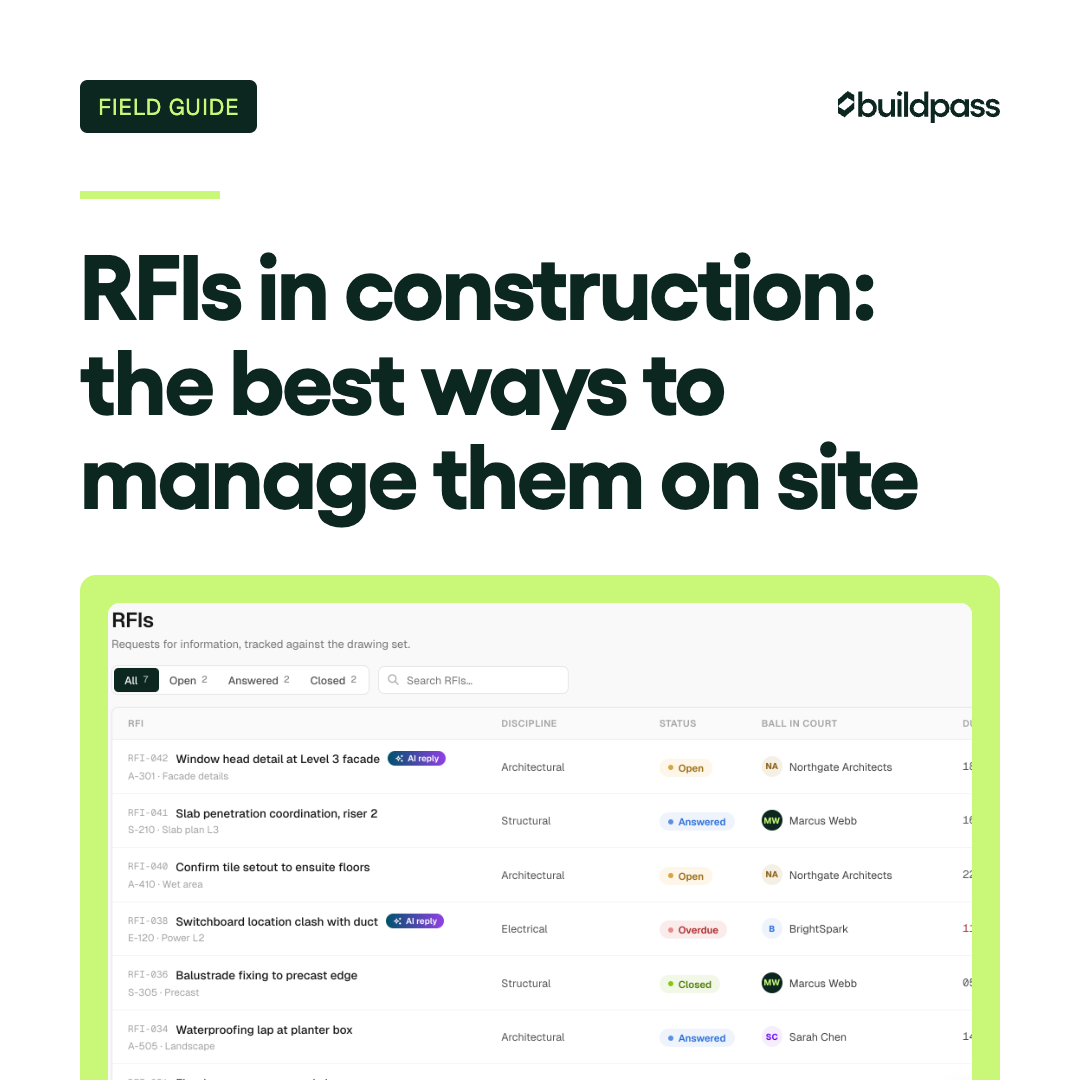
RFIs in construction: The best ways to manage them on site
An RFI is a formal request for clarification on drawings, specs, or contract documents. Here is how the process works and how to stop RFIs from stalling your jobs.

TL;DR
- An RFI (Request for Information) is a formal way to request clarification when drawings, specifications, or contract documents are unclear or incomplete.
- Raise an RFI whenever your team needs an answer before work can continue or a decision can be made on site.
- Poorly managed RFIs can slow down projects, create confusion between teams, and make it harder to track decisions later.
- A simple RFI process with clear ownership, response tracking, and documentation helps keep projects moving.
RFIs are a normal part of construction. No matter how much planning happens before a project starts, questions will come up once work begins.
The purpose of an RFI is to create a clear process for getting those questions answered and documenting the decision. When RFIs are managed well, they help prevent mistakes, keep teams aligned, and reduce delays.
The challenge is what happens when RFIs start building up. Without a clear process, questions can get lost across emails, phone calls, and conversations on site. Teams lose visibility over what has been asked, who is responsible for responding, and whether a decision has actually been made.
For builders managing multiple projects, having a simple way to track RFIs can make a significant difference to keeping work moving.
What is an RFI in construction?
An RFI (Request for Information) is a formal request for clarification when something in the construction documents is unclear, incomplete, or doesn't match what is happening on site.
RFIs are used to resolve questions around drawings, specifications, materials, or scope before work moves forward. The response creates a documented record of the decision, helping keep the project team aligned and reducing the risk of disputes later.
Typically, RFIs are raised by the contractor or subcontractor and sent to the relevant party for clarification, often the architect, engineer, or design consultant. The general contractor usually manages the process by reviewing requests, tracking responses, and making sure decisions are communicated back to the right teams.
RFIs are often confused with submittals and change orders, but they serve different purposes:
- RFI: Used when you need clarification. For example, a drawing detail is missing or two documents provide conflicting information.
- Submittal: Used to provide information for approval, such as product data, samples, or shop drawings, showing how the work will be completed.
- Change order: Used when there is a change to the agreed scope, cost, or schedule.
An RFI does not automatically mean there will be a change order. However, if the response identifies additional work, a design change, or a gap in the contract documents, it may lead to one.
When should a GC raise an RFI?
An RFI is the right tool when you need a documented answer before work can proceed. The five most common triggers:
- Missing specifications: a detail or requirement that the contract documents do not address at all
- Conflicting information: two documents say different things, for example the architectural drawings specify one ceiling height and the mechanical drawings show equipment that will not fit at that height
- Design clarifications: the design intent is unclear and proceeding without confirmation creates risk
- Material substitutions: a specified product is unavailable, discontinued, or unsuitable for conditions on site
- Constructability concerns: what is drawn cannot be built as designed without a resolution, or can only be built at a significantly different cost
A quick conversation with the architect, engineer, or owner may help identify the issue, but it does not replace the RFI process. The RFI creates a clear record of what was asked, who responded, and what direction was provided. For GCs managing multiple projects, keeping RFIs documented and tracked is critical. Without a central record, questions can get buried in emails, text messages, or conversations on site, making it harder to know what has been resolved and what still needs action.
What happens when RFIs pile up or stall?
A few open RFIs are normal on most construction projects. The problem starts when they are not tracked properly, owners are unclear, and unanswered questions begin affecting the work happening on site.
When RFIs sit unresolved, the first impact is usually delays. Crews may be unable to continue until they have clarification, leaving teams waiting or forcing them to make assumptions. Neither option is ideal. Waiting impacts productivity, while proceeding without approval can create rework later.
As RFIs build up, the schedule can also start to suffer. A delayed answer on one trade can affect following activities, create coordination issues between subcontractors, and put pressure on the project timeline.
Poor RFI management can also create cost and communication issues. Without a clear record of what was asked, who responded, and when the decision was made, it becomes harder to resolve disagreements about scope, responsibility, or changes.
The solution is not eliminating RFIs as they are an important part of the construction process. The goal is making sure every RFI has a clear owner, a response timeline, and a documented outcome so decisions do not get lost between the office and the jobsite.
How to write an RFI
A good RFI does more than ask a question. It gives the person reviewing it everything they need to provide a clear answer without having to come back with more questions.
The goal here is to make it easy for the architect, engineer, or owner to understand the issue, make a decision, and keep the project moving. A complete RFI should include:
- A clear title and RFI number. Give every RFI a unique reference number and a title that explains the issue. "RFI 024 – Mechanical clearance conflict at Level 3" is much more useful than "Question about drawings."
- Project details and document references. Include the project name, relevant drawing numbers, specification sections, or contract documents so everyone is looking at the same information.
- The date submitted and response deadline. RFIs are often tied to upcoming work activities. Including when a response is needed helps the reviewing team understand the impact of a delay.
- A clear explanation of the issue. Avoid vague questions. Explain what is unclear, where the issue is located, and why clarification is needed before work can continue.
- Supporting information. Include anything that helps explain the problem, such as site photos, marked-up drawings, sketches, or screenshots of conflicting documents.
- A recommended solution where possible. If your team has a practical solution, include it. Giving the architect or engineer something specific to review can speed up the decision-making process.
The biggest mistake GCs make with RFIs is treating them as simple questions rather than project records. A well-documented RFI helps keep decisions clear, reduces back-and-forth, and gives your team a record of why decisions were made.
For growing contractors managing multiple projects, having a consistent RFI process makes it easier to keep questions, responses, and project documentation organised as jobs get more complex.
How to stop RFIs from stalling your jobs
Knowing what an RFI is and knowing how to manage them across a whole project are two different things. Here is what separates a GC who runs RFIs well from one who is constantly chasing answers.
1. Set expectations before the project starts
RFIs work best when everyone understands the process upfront. Define how RFIs should be submitted, who is responsible for responding, and expected response times before work begins. Without clear expectations, important questions can sit unanswered while crews wait for direction.
2. Keep every RFI tracked in one place
RFIs are easy to lose when they are spread across email threads, spreadsheets, and conversations between project teams. A central record helps your team see:
- Which RFIs are open
- Who is responsible for the response
- What information has been provided
- Which items are holding up progress
For growing GCs managing multiple projects, having visibility across RFIs becomes increasingly important as the number of jobs and trades increases. BuildPass helps teams raise, assign, and track RFIs across projects, keeping important questions and responses connected instead of buried in inboxes.
3. Make ownership clear
Every open RFI should have someone responsible for following it through. Without clear ownership, questions can sit unanswered simply because everyone assumes someone else is handling them.
4. Give enough detail the first time
Incomplete RFIs create unnecessary back-and-forth. Include the relevant drawings, photos, specifications, and a clear explanation of the issue so the reviewer has everything needed to provide an answer. The faster someone understands the problem, the faster they can help resolve it.
5. Keep project information connected
RFIs rarely exist in isolation. They often relate to drawings, site conditions, safety documentation, schedules, and other project records. Keeping project information organised in one system makes it easier for office teams and site teams to find the context they need when decisions have to be made.
6. Avoid relying on inboxes to manage projects
Email is useful for communication, but it is not a project management system. Important decisions can get buried, attachments can be missed, and follow-ups can depend on someone remembering to check a thread. The right construction management platform should make it easier to track decisions and keep everyone aligned without adding more admin. If your RFI process still runs through email threads, you will lose track of open items. BuildPass keeps RFI tracking alongside your other site documentation so nothing falls between the cracks.
Frequently asked questions
What does RFI stand for in construction?
RFI stands for Request for Information. It is a formal document used on construction projects to request clarification from the design team, typically the architect or engineer, when something in the contract documents is unclear, missing, or in conflict with another document.
Who is responsible for responding to an RFI?
The architect or engineer of record is typically responsible for responding to RFIs related to design intent, drawings, and specs. For RFIs that involve scope or contract interpretation, the owner or their representative may respond. The GC or sub who raised the RFI is responsible for following up if a response is not received by the required date.
How long should an RFI response take?
Standard industry practice is 7 to 10 business days. The right timeframe depends on the complexity of the question and what is specified in the contract. The most important thing is that a required response date is stated in the RFI itself and agreed upon in the contract before work begins. Without a contractual requirement, response time is difficult to enforce.
What is the difference between an RFI and a change order?
An RFI clarifies something already in the contract when the documents are unclear or conflicting. A change order modifies the contract itself, adjusting scope, price, or schedule. An RFI can trigger a change order if the clarification reveals work that falls outside the original contract scope, but they are separate documents with distinct purposes. Treating them as interchangeable is a common source of disputes.
What is the difference between an RFI and a submittal?
A submittal is the contractor demonstrating they will use materials or methods that meet the contract requirements, such as product data sheets, samples, or shop drawings submitted for review and approval. An RFI is the contractor asking what the requirements are when the contract documents do not make them clear. Submittals confirm compliance. RFIs resolve ambiguity.
What should a GC do if an RFI response is overdue?
First, confirm the RFI was received by the right party. Then follow up in writing, referencing the original submission date and the required response date. If the contract specifies an RFI response time, cite it in the follow-up. Document every follow-up attempt. If the delay is affecting the schedule, put that in writing too. An RFI response delay that causes a work stoppage or schedule impact needs to be documented as it happens, not reconstructed later.
How many RFIs is normal on a construction project?
It varies by project size and complexity, but a common benchmark is 10 to 15 RFIs per $1 million in project value on a typical project. Significantly more than that is often a sign of incomplete contract documents, coordination issues in the design team, or an RFI process being used for things it was not designed for. Reducing RFI volume starts with better contract documents upfront.
What is an RFI log and why do you need one?
An RFI log is a centralized record of every RFI on a project: the RFI number, description, who it was submitted to, the submission date, the required response date, and the actual response date. It gives the project team a live view of what is open, what is overdue, and what has been resolved. Without one, open items fall through the cracks and the project loses visibility on pending decisions. On any project with more than a handful of RFIs, managing them without a log creates real exposure.
Managing RFIs well is a process problem as much as a paperwork problem. The GCs who stay on top of it are not doing anything complicated. They are tracking consistently, assigning ownership, and keeping documentation in one place rather than scattered across inboxes. BuildPass keeps your RFI tracking, site documentation, and project communications together so the whole team has visibility on what is open and what needs to move. Book a demo to see how it works on a live project.
More news you'll care about
Don't stop there, the BuildPass blog is filled with interesting insights and innovations that'll help you and your construction business stay ahead of the pack.