
AI 101 for builders: the webinar, the prompts, and how to move one level up the curve
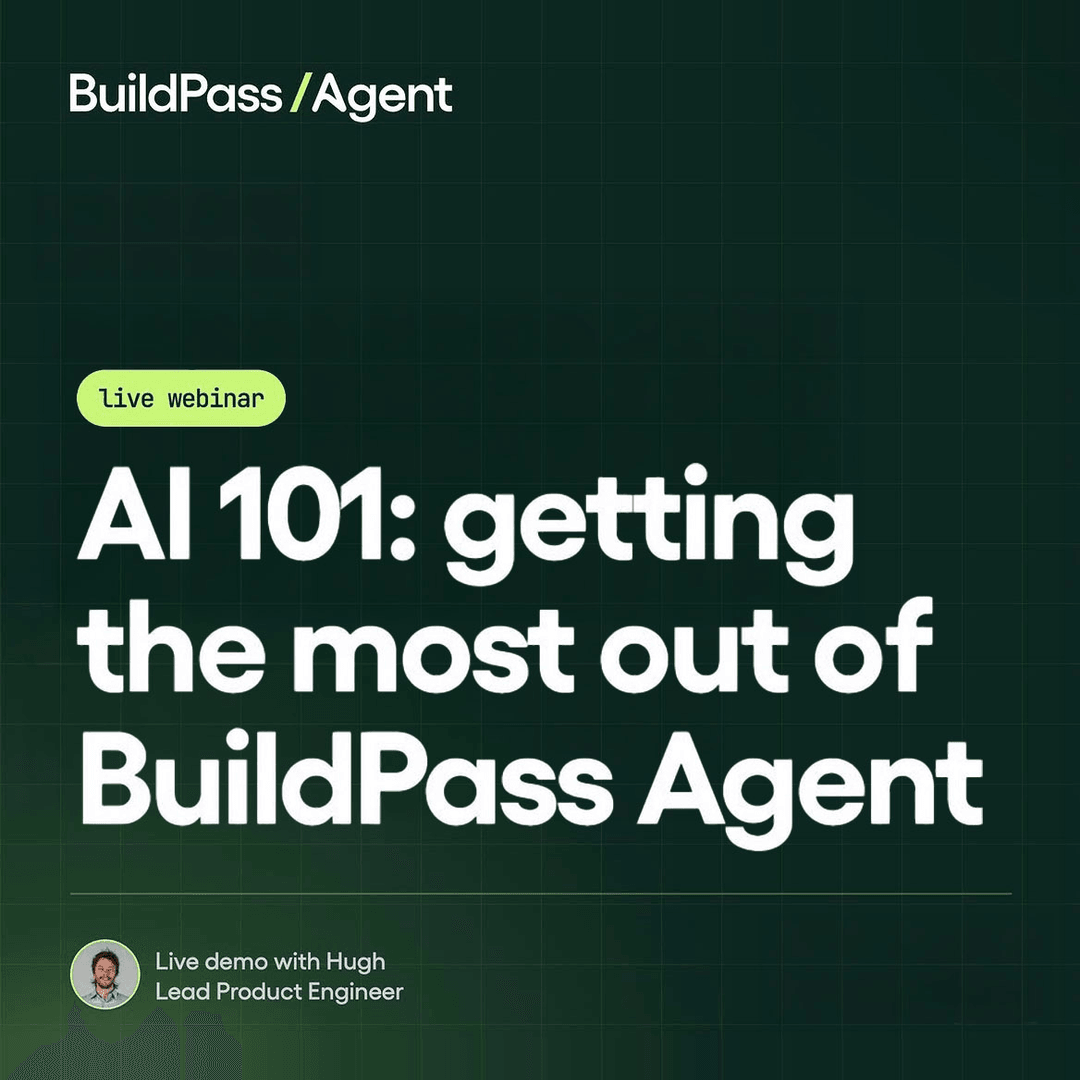
Watch BuildPass's first AI webinar in full, then steal the prompts. Hugh Rayner walks 100+ AU builders from what a model actually is to running Monday morning triage in one message and connecting Claude or ChatGPT straight into BuildPass.

Most of the builders on this call already use AI. Nine in ten, according to the sign-up survey, split pretty evenly between ChatGPT and Claude. So this was never going to be a beginners' session.
What Hugh Rayner, Lead Product Engineer at BuildPass and the person who built BuildPass Agent, set out to do on Thursday 10 September was different: get everyone to the same foundation in ten minutes, then spend the rest of the hour on what people with that foundation are actually doing with it. Filling a site diary from a voice note and the gallery. Turning a paper checklist into a template with one message. Pulling every project's defects into a single dashboard. Getting a report every weekday morning without asking.
It was the most questions we've ever had on a webinar. The full recording is above; below is the map, the prompts Hugh used, and the answers to the questions that kept coming up in the chat.
Jump to a section
- AI in five minutes, without the hand-waving
- The AI Maturity Curve
- Five things Hugh did live that you can do today
- Level 3: connect your own AI to BuildPass
- Universal search
- Frequently asked questions
- What's next
- Do one thing this week
AI in five minutes, without the hand-waving
Hugh's opening explanation is worth the first ten minutes on its own, because it takes the mystery out of everything that follows.
A model (Claude, ChatGPT, Gemini) is a big maths function. Text goes in, text comes out. The text is chopped into tokens, which is just how usage gets counted. A chat is you feeding tokens in and getting tokens back. The easiest mental model: it's autocomplete on your phone, if you kept hitting the first suggestion until it wrote a whole sentence.
A tool is what turns talking into doing. When the model replies in a very specific shape (something like open_record.defect followed by an ID) our code recognises that shape and acts on it. That's a tool call. BuildPass Agent has around 240 of them, which is why it can operate every part of the platform rather than a handful of features.
An agent is a chat that can do a lot of things before it comes back to you: look at all your defects, find the active ones, read those in detail, then answer. A background agent is one level up again: it wakes up and does the work without you starting a chat.
That's it. That's how BuildPass Agent works, how ChatGPT works, and how Claude Cowork works.
The AI Maturity Curve
Hugh's one ask of everyone on the call: work out where you sit, and leave one level higher.
Level 1: Ask. "How do I set up a permit?" "How many open drawings are on this project?" Useful. Saves you a bit of time.
Level 2: Delegate. "Review these drawings." "Write this report." "Pull the defects across all my projects and tell me which one is most concerning." This is where the time savings get serious.
Level 3: Connect and go proactive. Your AI is wired into BuildPass and SharePoint, Gmail, Xero, MS Project, your calendar, and it does jobs in the background without being asked. This is where you start automating the business rather than the task.
From a week of chat logs, most BuildPass customers are sitting at Level 1 heading into Level 2: building and operating checklists, researching companies and compliance, making reports and registers, asking how to do things. The rest of the webinar is about getting to Level 3.
Five things Hugh did live that you can do today
Every one of these runs inside BuildPass Agent, which is included on every plan. Open it from any page, start a new chat per task (a long chat that mixes jobs gets confused and expensive), and let it propose the approach rather than dictating every step.
1. Turn a paper form into a template
Hugh dropped a PDF of the webinar's own feedback form into a new chat with one line: make me a template from this. It came back a minute later with the digital version, pass/fail fields and sections intact, and a link to open it in the template editor. From there you edit side by side: rename the sections, I want two signature blocks.
It works best from an existing form because it matches your style. It can also go wider: what safety forms do you think are most important? Make them all. Table-style templates are supported from next week. The same engine powers the AI checklist generator if you would rather start from a description than a document.
2. Fill out today's site diary
New chat: fill out today's site diary. Agent read the template, pulled today's photos from the gallery, checked what defects were opened and whether the schedule was on track, proposed what it wanted to write, and filled the response once Hugh approved. Then: add that image to the response. It already had.
The more data you get into BuildPass, the better this gets. A voice note from the ute works just as well as typing. See site diaries for how the record itself is put together.
3. Review your open defects
Have a look at the defects on this project. Agent walked all seven, flagged what needed to go out, drafted responses and linked each record. Hugh had created those defects earlier from a single voice note, which is the other trick worth knowing: the voice button in the chat is often faster than the keyboard.
4. Monday morning triage, in one message
This was the opener and the payoff. Hugh typed let's do my Monday morning triage and got a full report: decisions needed, risks, schedule, progress, every overdue action, across the projects he cares about. No clicking through pages.
The reason a five-word message produced a full report is a saved memory. Weeks earlier he'd had a long chat refining exactly what he wanted in that report, then said this chat is so good, can you remember this for later? Now the instruction is stored, and any Monday he just asks.
Do this with anything you repeat. Save it for yourself, for a project, or for your whole builder account: remember that my forms always need a signature block at the bottom. It's the fastest way to make Agent work the way your business works.
5. Turn it into a PDF
Nice, I liked the report. Can I have it as a PDF? Done. The use case that lands is the client update: a saved format that reads your site diaries and schedule but leaves defects out, produced as a PDF you can send straight on.
Level 3: connect your own AI to BuildPass
If you already pay for Claude or ChatGPT, you can connect it to BuildPass in your account settings (top right, then AI Clients) using the BuildPass MCP connector. It uses your permissions and can do everything Agent can, plus everything else you've connected. Hugh's current recommendation for teams is Claude Cowork; it's the easiest to set up as an organisation and share skills across teammates, though the space moves fast.
What that unlocks, straight from the chat questions:
- SharePoint and Google Drive. Pull down this file from SharePoint and put it in BuildPass. Documents, drawings, gallery, attachments on a form response: anywhere a file lives in BuildPass, it can go. Set it to run every morning and new drawings that land in your inbox get filed without you.
- MS Project. Compare this program to my schedule in BuildPass and update what's changed. It works out the diff and applies it.
- Xero. Connected. Push sign-ons through to payroll.
- Your calendar. An hour before any meeting related to BuildPass, pull my project data and the meeting context and brief me.
Then the showcase: a custom dashboard tailored to four projects, defects and RFIs; a pattern analysis across every defect on every project (finish quality was the biggest problem, by trade, with sources); and the Melbourne office floor plan with every located defect pinned to it, photo attached. All built by describing what he wanted to know and letting the AI decide how.
Universal search
New, and rolling out now: every record, worker, document and photo in your account is searchable, including by what's in a photo, on the same engine as AI image tagging. Hugh searched his gallery for "crack" and "pipe" with nothing tagged; it found them. Someone submitted an incident two months ago about a knee? Search "knee". Command-K (Control-K on Windows) opens the same search from anywhere, and it's the main way Hugh gets around BuildPass.
Frequently asked questions
The ones that kept coming up in the chat.
If I turn on BuildPass AI, does our company data go into the cloud? It's transmitted the same way as any internet request, but we pay for enterprise AI with zero data retention: nothing is stored, nothing is used for training, and everything is processed and stored in your region (Australia for AU accounts, the US for US accounts).
Which AI should we connect? Claude Cowork today, for organisation set-up and shared skills. Try what fits your business; pricing changes constantly.
Is there a list of prompts that work best? Experiment, and don't over-specify. Say what you want, not how to do it: how many actions are unassigned? then can you assign them? and discuss from there.
Can Agent fix sign-on hours and cost codes? Yes. Look at the sign-on page and say it: make sure everyone on this project is signed off at 5pm, night shift included. It'll confirm before it changes anything.
Can a supervisor run reports on just their sites? Yes. Save the memory scoped to those projects, or if they only have access to those jobs it happens by default.
Can we force GPS sign-on? Yes, provided workers have the app; geofencing then fires as they walk on and off site.
Can workers add to the site diary? They can upload to the gallery or complete a shared template response; Agent pulls from both. The admin site diary itself stays admin-side.
Does Agent support videos? Not yet. Photos and PDFs today.
Why do notifications take five to ten minutes? Deliberate. We batch your changes so people get one notification, not one per edit.
What about meeting minutes, pre-starts in meetings and internal minutes? All coming with the meetings revamp rolling out soon, with the same integrated AI for note-taking, agendas and prep.
What's next
Your Daily Agent. Everyone on the call gets advance access. It runs every weekday morning, reads the projects and data you tell it to care about, and hands you an update (weekly wrap on Fridays) that you can continue in chat: dive into these, send those back, approve that. The next release lets it act as well as read: bounce a defect photo that isn't good enough, fill the site diary at 5pm every day. Everyone in BuildPass gets it within a few weeks.
Custom agents, built-in connectors, live voice are all on the roadmap.
Supasite and Supasnap. Free, iPhone today, Android on the way. Answer your work phone and the call is recorded, summarised and synced to BuildPass with tasks created, the same way phone calls work inside the platform. Walk the site with Supasnap (photos, video, voice notes) and Agent picks it up to write your defects or site diary. supasite.com
Win/Pay. James Formica covered where AI already sits in takeoffs, estimating, tendering, contracts, purchase orders, invoices, budgets, variations and progress claims (smart compare, bill categorisation, Xero). Agent access to Win/Pay data is the next piece to open.
Do one thing this week
Hugh's closing ask, and ours. Pick your level and move up one:
- Not on yet? Settings, turn on AI Tools, toggle BuildPass Agent. Included on every plan.
- Asking? Start delegating. Save a memory for the thing you do every week.
- Delegating? Connect Claude or ChatGPT to BuildPass in AI Clients and wire in one other system.
- New starters, or want a refresher? JT runs the BuildPass Basics webinar; the next one's on your dashboard.
- Something not working the way you expect? Tell Agent: submit feedback, I want to be able to do X. Hugh reads every one.
More news you'll care about
Don't stop there, the BuildPass blog is filled with interesting insights and innovations that'll help you and your construction business stay ahead of the pack.