
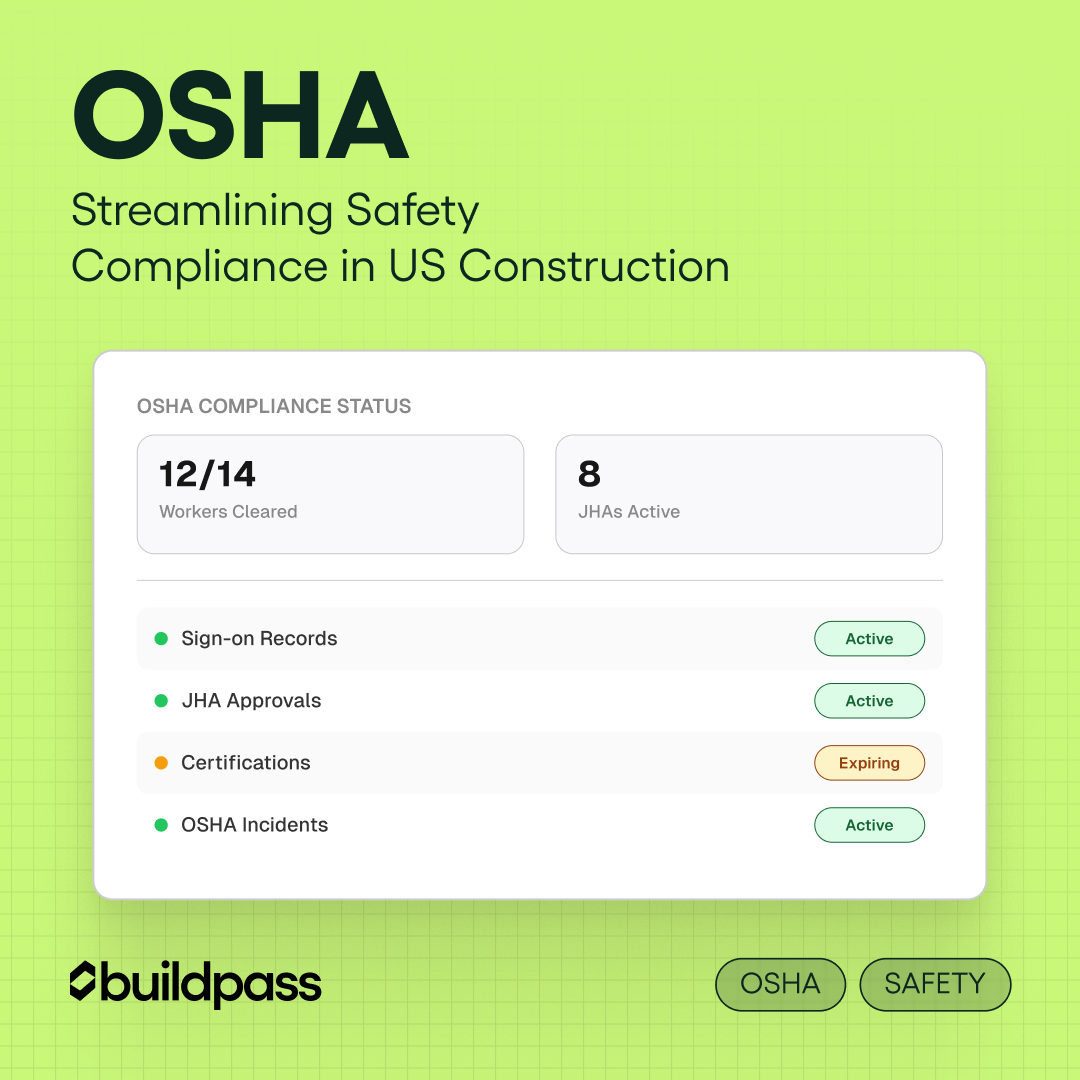
Streamlining Safety Compliance in US Construction
A practical guide to OSHA compliance for US contractors. See how construction safety software cuts paperwork and keeps your sites audit-ready.

If you're running a US construction site, OSHA compliance doesn't sleep. One inspection, one missing form, one expired certification, and the costs add up fast.
The site keeps moving. Subs roll in. Tasks shift. Weather changes the plan. Safety paperwork is meant to keep up, but most teams still chase it on clipboards, in shared folders, and across email threads no one wants to open.
This post breaks down what OSHA actually expects from construction employers, where compliance tends to slip, and how construction safety software helps you run a tighter site without piling on admin.
What OSHA actually requires on a construction site
OSHA (Occupational Safety and Health Administration) regulates construction safety under 29 CFR Part 1926. The detail can get heavy, but the day-to-day duties land in a few buckets.
- Hazard communication. Workers need to know the hazards on site and how to handle them. That covers SDS for chemicals, fall hazards, electrical risks, and any task-specific risks.
- Training. Employees must be trained on the specific work they're doing and the safety procedures attached to it. Training records need to be available on request.
- PPE. The right gear, properly maintained, used the right way.
- Inspections. Regular safety inspections of the site, equipment, and high-risk work.
- Recordkeeping. OSHA 300 logs, incident reports, training records, JHAs, and exposure data, kept for the periods OSHA requires.
- Reporting. Serious incidents reported within 8 to 24 hours depending on the outcome.
Penalties for serious violations sit around $16,131 per violation under current OSHA maximums, and willful or repeated violations can run over $161,000 each. The upside of getting this right is real.
Where compliance usually breaks down
Most teams aren't failing because they don't know the rules. They're failing because the systems aren't built to keep up with how a real site runs.
The recurring pressure points:
- Orientation records that live on paper or in someone's inbox
- JHAs that never get reviewed before work starts
- Subcontractor insurance and certifications that quietly expire mid-project
- Toolbox meetings that happen but never get logged
- Incident reports that get written days late, or not at all
- Different sites running different processes, with no central visibility
When OSHA shows up, or when something goes wrong, the gap between "we do this" and "we can prove we did this" is where projects get hurt.
How construction safety software keeps your site OSHA-ready
Compliance gets easier when the system is built around the realities of a site, not an office.
Step 1: Centralize every safety record
A single digital hub for orientations, JHAs, permits, certifications, insurances, SDS, and inspections gives you one source of truth. No chasing folders. No missing forms.
Step 2: Run it on mobile
Workers, superintendents, and safety officers are on site, not at a desk. Forms, sign-ons, and inspections need to work on a phone or tablet, with offline access for sites where service drops.
Step 3: Automate the reminders
Expiring certifications, lapsed insurances, overdue inspections, untracked toolbox meetings. A good system flags these before they become an OSHA problem.
Step 4: Build approval into the workflow
JHAs get reviewed and approved before high-risk work begins. Permits require sign-off. Construction safety software handles this without you having to babysit it.
Step 5: Track who's on site, in real time
Sign-ons connected to orientation status mean nobody walks onto site without being cleared. If something happens, you know exactly who was where.
Step 6: Keep records that are inspection-ready
When OSHA shows up, pull every record they ask for in minutes. Digital storage with timestamped activity makes that the default, not an emergency.
How BuildPass helps US contractors stay OSHA compliant
BuildPass is a construction safety management app built to keep all this work in one place.
Workers complete their site orientation by scanning a QR code, upload their certifications, and sign on through the app. JHAs are built in the JHA Builder, reviewed against a checklist, and signed digitally before high-risk work starts. Toolbox meetings, safety inspections, permits, and incident reports are all logged with timestamps and stored against the project.
For contractors running multiple sites, the dashboard rolls up compliance status across every active project. You can see which workers are cleared, which JHAs need review, which insurances are about to expire, and which inspections are overdue, without calling a superintendent.
Less time chasing paperwork. More time running the site.
Picking the right construction safety software
Not every tool is built for construction. When you're shortlisting options, focus on:
- Mobile-first design. Site teams won't use desktop-only systems.
- OSHA-aligned templates. JHAs, permits, and inspections that match what regulators expect.
- Subcontractor access. Subs upload their own docs instead of emailing them to you.
- Real-time visibility. One dashboard across every site.
- Document expiry tracking. Certifications and insurances flag before they lapse.
- Audit trail. Timestamped records for inspections and incidents.
If a platform forces site teams to change how they already work, it'll get ignored. The best safety software for construction makes compliance the easier path, not the harder one.
Frequently asked questions
How do I keep my construction site OSHA compliant without piling on admin?
Move your safety records, JHAs, orientations, certifications, and inspections into one digital system. Construction safety software automates reminders, captures sign-offs, and keeps everything inspection-ready. The admin shrinks because the work happens once and stays where you need it.
What does OSHA actually require from construction employers on site?
OSHA requires you to identify hazards, train workers, provide PPE, run regular inspections, keep accurate records of incidents and exposures, and report serious incidents within strict timeframes. The full requirements sit in 29 CFR Part 1926, and the details vary by work type.
How do I manage OSHA compliance across multiple construction sites?
Use a centralized construction safety management platform with a single dashboard across every project. You should be able to see orientation status, JHA approvals, certification expiries, and inspection schedules at a glance, without calling site superintendents.
What records do I need to be ready for an OSHA inspection?
At a minimum: OSHA 300 logs, training records, JHAs, permits, certifications, SDS, equipment inspection records, incident reports, and any exposure monitoring data. Keep them organized by project, timestamped, and accessible on a phone or tablet so you can pull them quickly.
What's the best construction safety software for US contractors?
The right choice depends on the size of your operation and how your sites are run. Look for mobile-first design, OSHA-aligned templates, subcontractor access, document expiry tracking, and real-time visibility across all your sites. BuildPass is built for GCs running 5 to 20 projects, not Tier 1 enterprise contractors with dedicated IT teams.
Book a demo today.
More news you'll care about
Don't stop there, the BuildPass blog is filled with interesting insights and innovations that'll help you and your construction business stay ahead of the pack.