
How builders can ensure worker well-being on site
A practical look at worker well-being on construction sites, covering safety, fatigue, and mental health, and how BuildPass helps reduce pressure and improve site conditions.

Construction sites prioritize safety. Safety programs are in place, orientations are completed, PPE is issued, and compliance boxes are ticked.
But there's often a gap between being compliant and making sure people are properly looked after on site.
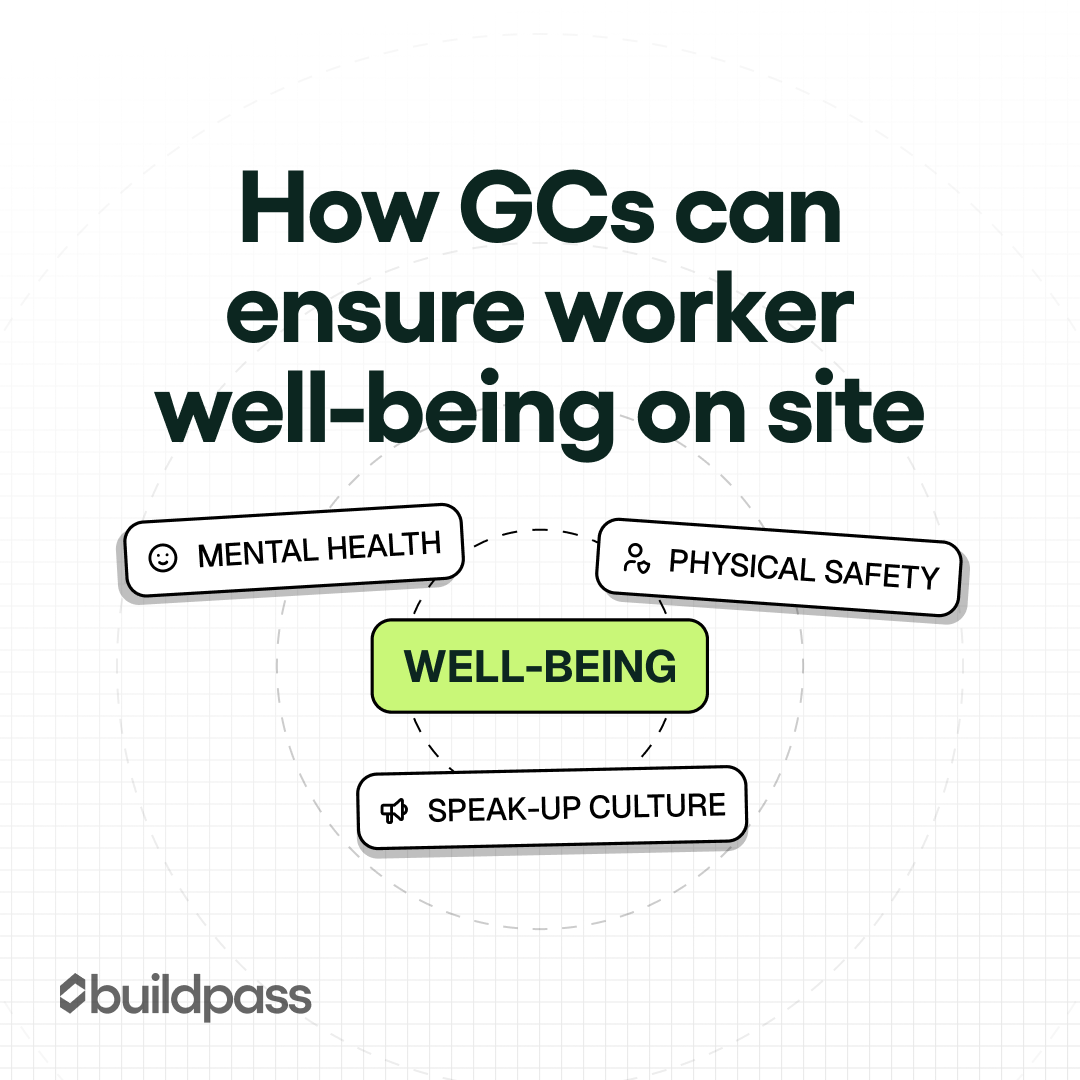
Worker well-being goes beyond a construction safety program. It's about how people are treated during long shifts, how fatigue is managed on busy projects, and whether site culture supports workers speaking up when something doesn't feel right.
In this article, we'll break down what worker well-being actually looks like on a job site, including physical safety, fatigue, and mental health.
Physical safety is still the baseline
A strong construction safety program starts with the basics being done properly every single day.
That means clear hazard communication, proper PPE use, safe equipment handling, and making sure every worker understands the risks of the job before stepping onto site. A safety program only works when it's consistently applied, not just during audits or at project kickoff.
But even when physical safety systems are in place, it doesn't automatically mean workers are supported in a broader sense.
Fatigue is one of the most overlooked risks
One of the biggest issues on job sites is worker fatigue. Long hours, early starts, and physically demanding work all contribute to workers pushing through tiredness more often than they should.
Research shows this is more than just a feeling. In a survey of 606 construction workers in the US, 49% reported being "tired some days" in the past three months, and 10% reported being "tired most days or every day." Workers who felt tired some days were also significantly more likely to report difficulty with physical function compared with those who rarely felt tired.
Fatigue directly affects coordination, reaction time, and decision-making, all of which are critical to safety on site. On busy projects, that increases the likelihood of mistakes and preventable incidents.
Managing fatigue is often treated as a secondary concern in a typical safety program, but it plays a major role in the actual conditions workers face day to day.
Mental health on site matters more than people talk about
Mental health is still one of the most underaddressed parts of construction safety.
Mental health challenges often appear as stress, anxiety, burnout, or disengagement. They're not always visible on the surface, but they affect how workers show up, how they communicate, and how they respond under pressure.
The numbers reflect this growing reality. Nearly two-thirds (64%) of US construction workers say they've experienced anxiety or depression in 2025, up from 54% the year before.
That kind of shift shows this isn't a background issue anymore. It's becoming a regular part of the workforce experience, and it connects directly back to site safety, even if it isn't always treated that way.
Supporting mental health doesn't require complex programs to start. It begins with normalizing conversations and creating a site culture where workers feel comfortable speaking up before small issues become bigger ones.
Practical tools that support well-being on site
Good safety management doesn't just come from having the right policies in place. It comes down to how smoothly those processes actually run on site, when things are moving fast and people don't have time to chase down information.
BuildPass supports worker well-being by removing friction from everyday safety processes. Instead of chasing paperwork, repeating orientations, or second-guessing whether someone is cleared to be on site, everything is handled in one place.
That means less confusion, fewer delays, and less pressure on both workers and superintendents. When safety processes run smoothly, it reduces mental load on site and gives teams more time to focus on the work itself.
Book a demo today!
More news you'll care about
Don't stop there, the BuildPass blog is filled with interesting insights and innovations that'll help you and your construction business stay ahead of the pack.